
Counting Lights

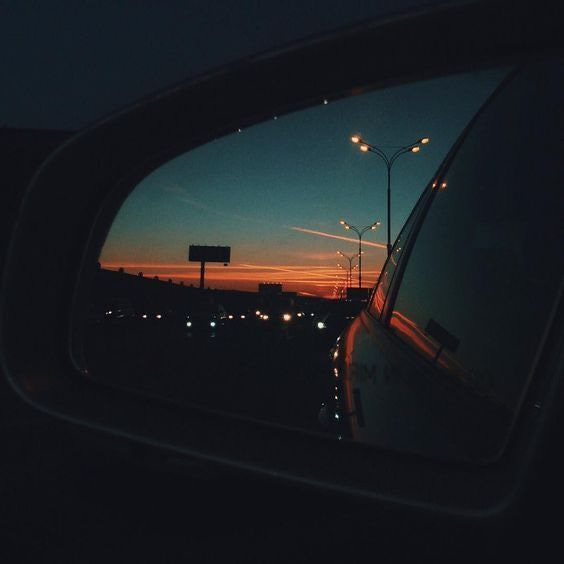
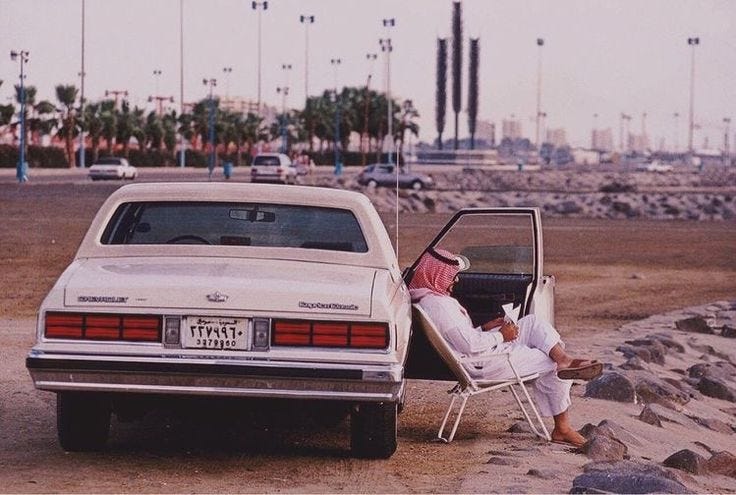
We grew up in Saudi Arabia. A different Saudi Arabia than the one you probably relate to these days.
We grew up at a time when there was little to do in one place, but lots to do if you travelled a good distance. My dad owned several cars over the years. Owning a Chevy, of any kind, was a normal sight. The terrain, the weather, the heat, the big families, the long drives, the lack of good public transportation, everything said you should own one.
My memories are full of Chevrolet Caprice Wagons and Chevrolet Suburbans.
Sitting in the back, in those extra big comfortable seats. Since traffic laws were still not as thorough as now, lying in the back of the car was never considered dangerous.
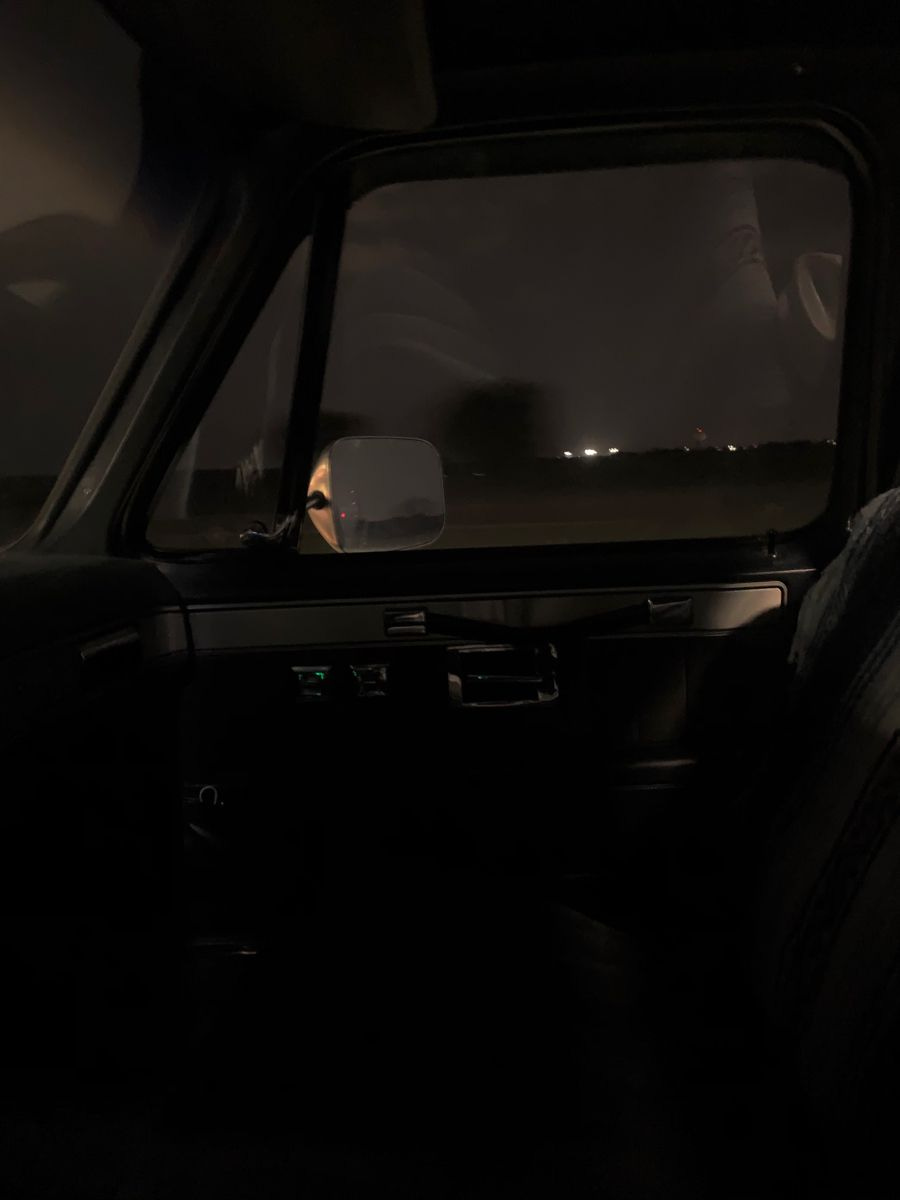
I have memories of lying in the back of that wagon, facing the night sky as my dad drove at a very steady speed that made calculating the road lights very easy. I used to play games by myself. Counting the lights on familiar roads. Guessing where we were or where we had reached without ever looking around me.
It was an elaborate science. Counting lights. Identifying which light poles belonged to what type of road. Calculating the route with every turn and every traffic light.
The Suburbans had a different feeling. They meant we were out with friends, all jammed into that bus of a car. It was the times when I knew I could open doors and walk right into a different moment, even when I was fully surrounded by people.
The Suburbans meant longer drives, faster distances, mostly at night. Because that’s when the adults came back from work, and that’s when the weather was much more tolerable.
Long drives meant travelling between cities, which meant passing through the desert, which meant less city lights, which meant the night sky.
There was something special about the desert night sky. The darkness that turns into bright light as the stars illuminate everything. In a moving car, the stars don’t move. They follow you. The moon is right there, feeling like a companion from the moment you drive until you arrive. It feels as if it’s there, just there for you.
My dad once told me, in frustration after 100 questions about the moon, that we are not moving, but the Earth is. Hence, everything looks static and motionless up there.
The doors that opened up after that explanation were a roller coaster. Mostly because the science didn’t add up.
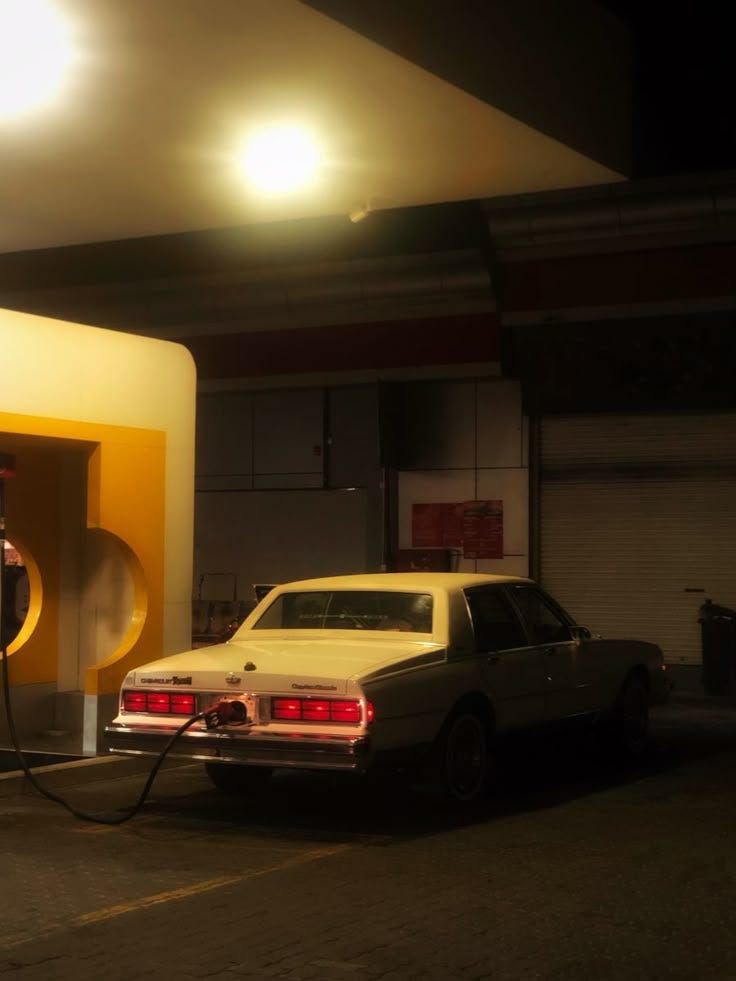
I never stopped doing this.
I just didn’t have language for it. I didn’t think of it as “doors” or “imagination” or “creativity.” It was just what I did. How I passed the time. How I made sense of things. How I solved problems that didn’t have obvious solutions.
I counted lights in the back of a Suburban. I built elaborate systems in my head to track where we were without looking. I asked questions that opened more questions. I let explanations that didn’t quite fit spin into entirely new directions.
And I kept doing it. Through school. Through university. Through every job, every team, every project.
Some spaces welcomed it. Some didn’t.
The worst places were spaces where imagination died, where creativity was stifled.
I was employed once by a manager who was scared of creativity and imagination. He would go out of his way to ensure thoughts and ideas were stripped of any perspectives that could defy his authority.
I didn’t see that on the spot. But I know it now in retrospect. And I know that the depression-like feeling I had during that time was a byproduct of that management style.
The worst play dates I ever had were with people who only built their toys as the manual said. Every single time.
The worst car interiors I drove were those which didn’t feel like a designer tried something new, risky, or out of the ordinary.
Dull offices I walked into. No music, no colours, no greenery, no artworks, no DIY projects. Just offices that look the same with or without people.
These are spaces where the door doesn’t exist. Or worse, where it’s been sealed shut deliberately.
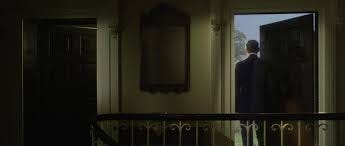
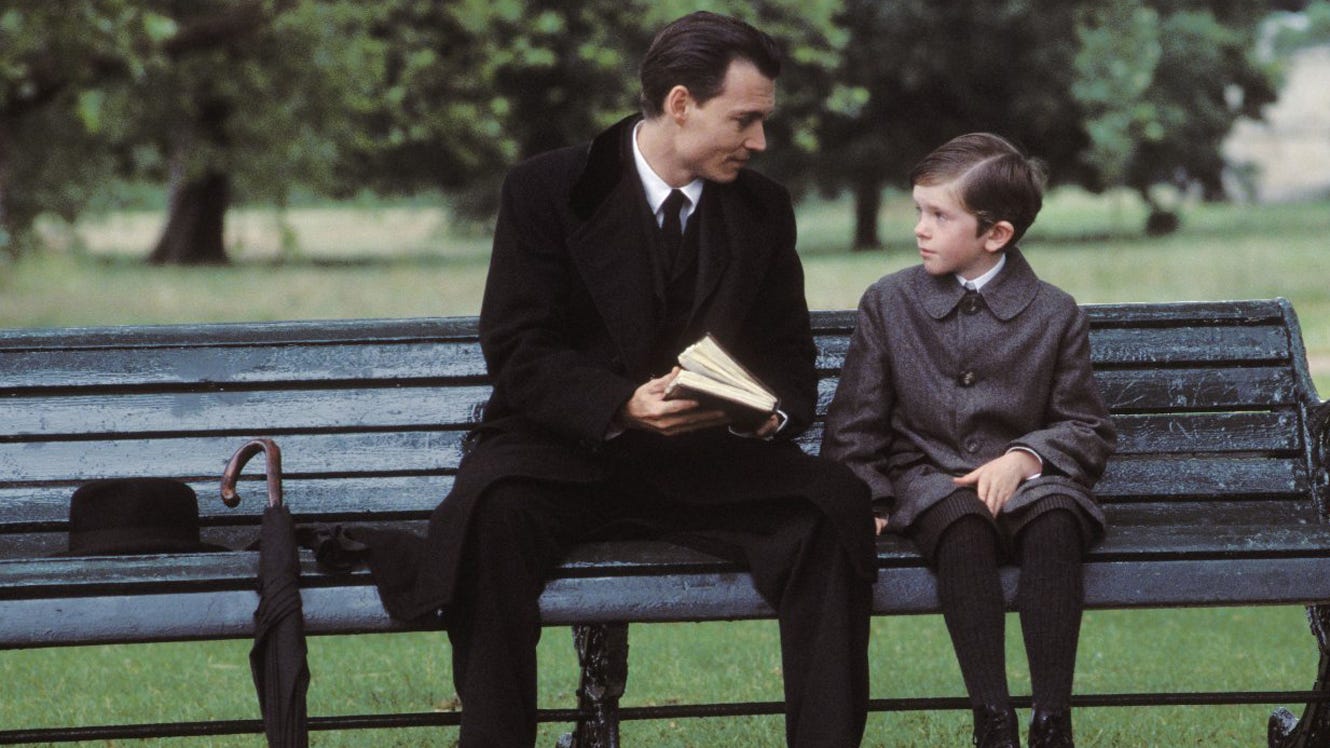
There is a scene in the movie Finding Neverland. A couple of seconds long. You might have missed it, or it probably meant everything to you about this film.
After a quiet, strained argument, James and Mary walk down a hallway in their home toward their separate bedrooms. Each opens their respective bedroom door at roughly the same time.
When Mary opens her door, she steps into a dark, normal bedroom. The rigid, gloomy reality of high society. The inability to embrace imagination and whimsy.
When James opens his door, a subtle but starkly beautiful visual effect shows that beyond his doorway lies a sunlit forest of greenery and blue sky. An image of the natural, imaginative world he is creating in his mind and in his writing.
That scene brought everything together for me.
I never thought of it as doors before. Yet it was, all along.
The Suburban. The counting lights. The questions about the moon. The spaces I welcomed and the spaces I fled. The depression under that manager and the energy with the accountant, I’ll tell you about.
All of it. Doors.
Some of us walk through that door with James into the forest. Some walk with Mary into the dark bedroom.
And I’ve been choosing which door to walk through my whole life without realising that’s what I was doing.
I like to say I worked with creative people all my life, but that wouldn’t be fair. Because that would give you the idea that I spent my life around creators, designers, engineers, artists, and crafty people.
And although this is mostly true, it’s not the full picture.
We tend to rob people of words like creativity and imagination, and reserve them for certain individuals, certain trades and crafts. I don’t think that is fair.
There was an accountant I worked with once. He noticed we were paying extra for some services we required, apps, more specifically, and he asked me for a meeting to discuss.
I walked into the meeting that day with the assumption that I was walking into a room full of statements, balance sheets, and mostly spreadsheets. I was off by miles.
I walked into a room with colourful post-its, a whiteboard with a few notes on it, and some stacks of papers that had more words than numbers. Of course, there were spreadsheets, but they were not the central pieces on that table.
He had ideas. Ways to invest. He dove deep into finding opportunities to maximise those investments in those apps. I remind you, he is an accountant. Normally, a profession people hastily assume is not on the creative edge of things.
He confessed that the post-its were a way to satisfy my itch. I graduated from a school of thought and practice that lies heavily on post-its.
He took a predicted presentation into a whole new experience. He did it because he invested his creativity in putting the whole thing together. It worked because we, as a team, didn’t fear that. We welcomed it.
My daughters are growing up knowing I dislike the term “bored” when it’s followed by complaints. Boredom is normal, but it should be a drive to be creative.
I allow more space in the house for creative projects. This also applies to a messy, out-of-this-world mess of leftover stuff and toys and tools around the house. I know for some people the house is not a workshop, but I can’t imagine it any other way.
My wife tolerates this. I think.
But I’m teaching them the same thing I learned in the back of that Suburban without knowing I was learning it. That you can build elaborate systems out of nothing. Those questions that don’t have answers are better than answers that don’t have questions. That the science not adding up isn’t a problem, it’s an invitation.
There is a hadith qudsi that the Prophet (peace be upon him) narrates from Allah:
أعددتُ لعبادي الصالحينَ ما لا عينٌ رأت ولا أذنٌ سمعت ولا خطرَ على قلبِ بشرٍ
“I have prepared for My righteous servants what no eye has seen, no ear has heard, and what has never crossed the mind of man.”
Ibn Abbas (may Allah be pleased with him) said:
ليسَ في الجنَّةِ شيءٌ مِمَّا في الدُّنيا إلَّا الأسماءُ
“There is nothing in Paradise that exists in this world except the names.”
How can you read these and not see that creativity and imagination are part of who we are meant to be?
Allah is telling us: imagine beyond what you’ve experienced. Paradise isn’t just better versions of what exists. It’s entirely beyond imagination.
Which means imagination itself is a divine gift. A tool for understanding that there’s more than what we see. That our role as vicegerents on this earth requires us to imagine what doesn’t exist yet and bring it into being.
The Islamic perspective on creativity, explored by scholars like Dr Samih Mahmoud Al-Karasneh and Dr Ali Mohammad Jubran, frames it as part of our purpose. Travelling, observation, seeing, hearing, thinking. These are methodologies of creativity rooted in faith.
I think their work is worth studying, even if you disagree with parts of it.

There is a video, a talk by John Cleese on creativity, that I return to often. He talks about two modes: the closed mode, where most of us operate, active and purposeful and anxious. And the open mode, relaxed and contemplative, where creativity lives. Where doors open.
Most organisations are designed to keep us in the closed mode. High stress. No space to think without an immediate purpose.
But creativity requires the open mode. It requires walking through that door into the forest, even if just for a moment.
I walk through that door with James into my Neverland every time I go to bed. Every time I wake up. Every time I need a moment away. Every time I need a solution.
I’m lucky, alhamdullilah. I can walk through doors on command.
But I refuse to be in a space where I don’t allow people to explore their own doors. Give them the keys. Even if we’re just having a conversation, a presentation, a review.
I’ve spent my career trying to create teams where people feel safe walking through that door. Not because I’m generous. Because I know what gets lost when people don’t.
The accountant with his post-its. The ideas he wouldn’t have surfaced if he’d just stuck to spreadsheets. The solutions we find when someone is allowed to imagine a different way forward.
That’s what happens when you police imagination. When you reserve it for “creative” people. When you treat it as a luxury rather than a necessity.
You lose solutions. You lose innovations. You lose the perspective that comes from someone counting lights in their head while everyone else is just sitting in traffic.
If you’re reading this and recognising yourself, if you’ve been told to “be practical” or “stop daydreaming,” if you’ve learned to keep your imagination internal because the rooms you’re in don’t welcome it, I need you to know something.
That door is still there.
The one James walks through. The one that leads to the sunlit forest, while everyone else walks into dark bedrooms.
You haven’t lost access to it. You’ve just been taught not to use it.
You might have counted lights in the back of a Suburban, or built elaborate games out of nothing, or asked questions that spiralled into bigger questions. You might have stopped doing it because someone told you to grow up, be serious, and focus on what matters.
But imagination isn’t reserved for certain people or certain professions. It’s not a luxury. It’s not frivolous.
It’s how you solve problems no one else sees yet. It’s how you create solutions that don’t exist. It’s how you fulfil your purpose as someone placed on this earth to imagine and build and contribute something beyond the immediate, the practical, the already-tried.
Find the conditions you need. The space. The time. The permission to play with ideas without an immediate purpose.
Walk through that door deliberately. Every day if you can. Every time you need a solution. Every time you need a moment away.
I admire posts, notes, articles, and anything that instantly invites me to walk through that door. Some people don’t know that their work, their existence, is the door people like me seek every day.
And sometimes, without knowing it, your work, your existence, becomes the door someone else walks through.
Chevrolet released a wonderful holiday ad dedicated to the Suburbans. It touched on memories, on moments, on journeys, and it kept the doors open for many families to walk through.
The doors matter.
Keep them open.
Thanks for reading Within the Margin of Error! I truly appreciate you taking the time to read my words. I hope I was able to bring you some value in exchange.
Keep Creating.
Hey, great read as always. It's fascinating how our brains, even in childhood, engage in such complex cognitive mapping and pattern recognition, turning simple observations into elaborate personal algorithims. I sometimes find myself doing something similar during my Pilates sessions, mentally tracking sequences and body positions, kinda like a physical logic program.